
Introduction
Multi-axis synchronized motion is the backbone of precision automation, enabling coordinated movement across multiple servo motors in applications such as robotics, packaging, semiconductor manufacturing, and optical alignment. At its core, synchronized motion ensures that each axis follows a defined relationship, maintaining accuracy, timing, and efficiency.
Key Principles of Multi-Axis Synchronization
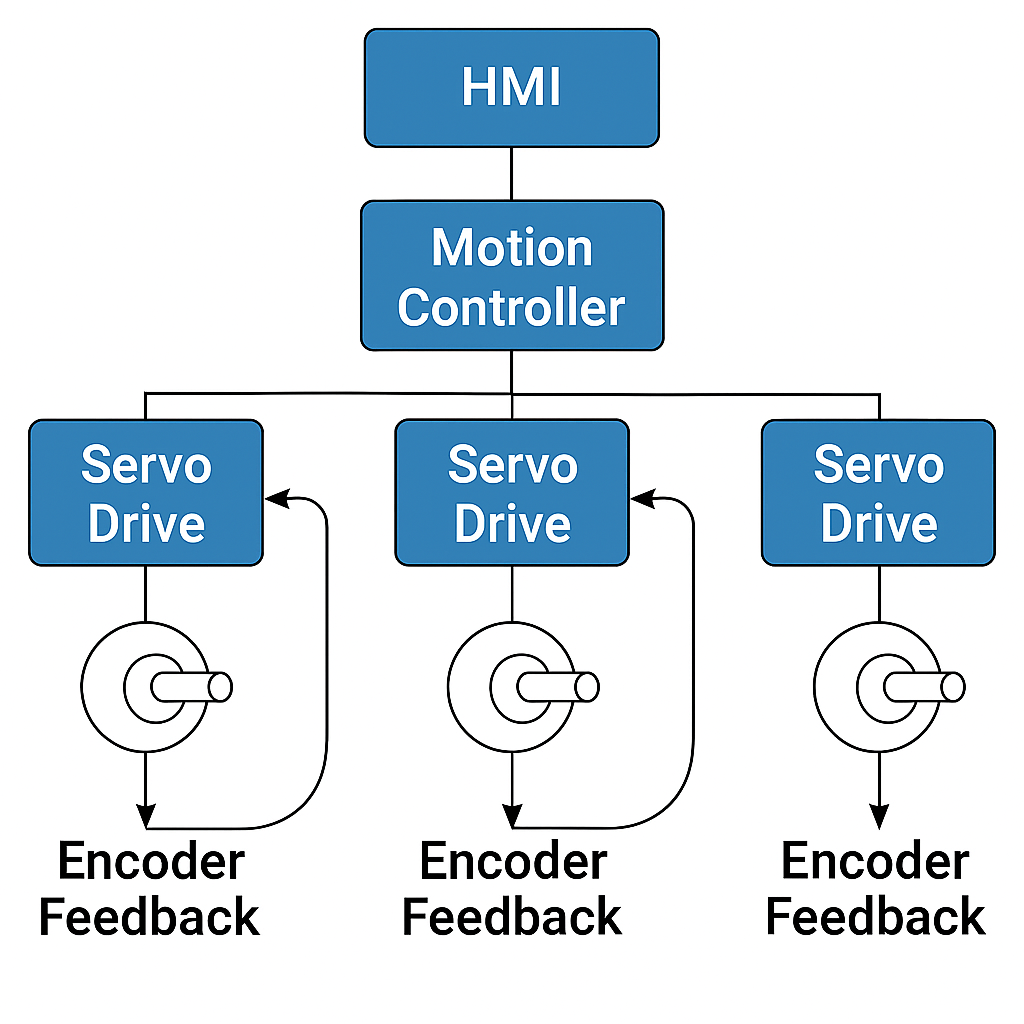
Multi-axis motion control relies on closed-loop feedback, real-time communication, and advanced coordination techniques to execute precise movements.
1. Closed-Loop Control for Each Axis
Each servo motor operates in a closed-loop system, adjusting:
- Position: Ensuring accurate movement within the defined motion profile.
- Velocity: Regulating speed for smooth and efficient transitions.
- Torque: Managing force to optimize motion performance.
Feedback from encoders (absolute and incremental) provides real-time data, allowing the system to refine movement dynamically.
2. Centralized Motion Coordination
A multi-axis motion controller serves as the master, orchestrating motion across all axes by:
- Trajectory Planning: Defining synchronized motion profiles to maintain seamless operation.
- Timing Alignment: Utilizing a shared clock to ensure accurate execution.
- Dynamic Feedback Integration: Continuously adjusting commands based on encoder feedback.
3. Communication & Real-Time Synchronization
Modern multi-axis systems leverage high-speed communication protocols:
- EtherCAT Distributed Clocks: Provides precise timing synchronization for real-time coordinated motion.
- SERCOS Real-Time Communication: Ensures deterministic, high-speed data exchange between controllers and drives.
- CANopen & PROFINET: Enables seamless coordination between industrial automation components.
4. Advanced Motion Techniques
To maintain synchronization, motion controllers employ:
- Electronic Gearing: One axis (master) dictates movement, while others adjust based on predefined ratios.
- Electronic Cam Profiles: Allows axes to execute complex, dynamic motion sequences.
- Master-Slave Configuration: One axis serves as a reference, ensuring synchronized response from all others.
5. Execution Timing & Latency Compensation
Achieving precise synchronization requires accurate execution timing:
- Interrupt-Based Synchronization: Motion controllers trigger execution with precise timing signals.
- Network Latency Adjustment: Compensates for communication delays to maintain real-time accuracy.
Applications of Multi-Axis Motion Control
Multi-axis synchronization is critical in:
- Robotics: Coordinating joint movements for seamless motion execution.
- Automated Assembly & Packaging: Ensuring consistent material handling and processing.
- Semiconductor & Optics: Aligning precision stages for ultra-high accuracy.
Conclusion
Multi-axis synchronized motion control transforms industrial automation by delivering precision, reliability, and efficiency. By leveraging advanced motion planning, real-time communication, and dynamic feedback, industries achieve seamless motion across complex systems.