T-Slot Aluminum Extrusions
20/30/40/45/60-series profiles, connectors, plates, panels, and hardware. Specify series, slot size, profile, length, finish, and machining — we’ll source cut-to-length kits with hardware.
20 Series
6 mm slot · 2020 / 2040
30 Series
8 mm slot · 3030 / 3060
40 Series
8/10 mm slot · 4040 / 4080
45 Series
10 mm slot · 4545 / 4590
60 Series
10 mm slot · Heavy duty
Accessories
Brackets · Plates · Panels
Compare T-Slot Extrusion Families
Toggle columns to focus on the sizes you use.| Criteria | Metric 20 Series 20×20, 20×40 |
Metric 30 Series 30×30, 30×60 |
Metric 40 Series 40×40, 40×80 |
Metric 45 Series (Bosch) 45×45, 45×90 |
Imperial 10 Series 1.0″ / 6-slot |
Imperial 15 Series 1.5″ / 8-slot |
|---|---|---|---|---|---|---|
| Typical slot width | 6 mm (M4–M5 fasteners) | 8 mm (M5–M6) | 8–10 mm (M6–M8) | 10 mm (M8) | .255″ (1/4-20) | .322″ (5/16-18) |
| Strength / stiffness | Light duty; small frames, guards. | Light–medium duty; equipment stands. | Medium–heavy; cells, machine frames. | Heavy duty; high stiffness Bosch pattern. | Light duty fixtures, carts. | Medium–heavy; common for machine frames. |
| Common profiles | 20×20, 20×40, 20×60 (lite) | 30×30, 30×60, 30×90 | 40×40, 40×80, 40×120, 80×80 | 45×45, 45×90, 90×90 | 1×1, 1×2, 1×3 (smooth/ribbed) | 1.5×1.5, 1.5×3, 3×3 (HT variants) |
| Connector ecosystem | Anchor, corner, hidden fasteners. | Wide availability; angle gussets. | Largest accessory range. | Bosch-compatible joining plates. | 80/20 10-series hardware. | 80/20 15-series / heavy plates. |
| Panel & door build | 3–4 mm panels, light guards. | 4–5 mm panels, hinged doors. | 4–6 mm panels; larger doors. | 6–8 mm panels; robust doors. | .125″ panels typical. | .125–.187″ panels typical. |
| Span guidance* | < 600 mm light loads | 600–900 mm light/med | 900–1500 mm med/heavy | 1200–1800 mm heavy | < 24″ light | 24–60″ med/heavy |
| Finish / corrosion | Anodized Al (clear/black) | Anodized Al (clear/black) | Anodized; hard-anodize options | Anodized; ESD options | Anodized; painted accessories | Anodized; stainless hardware avail. |
| Compatibility notes | Metric hardware; 6-mm slot nuts. | Metric; 8-mm slot nuts. | Metric; most catalog accessories fit. | Bosch slot geometry; check plates. | Imperial; 10-series only. | Imperial; 15-series only. |
| Relative cost | $ | $–$$ | $$ | $$–$$$ | $ | $$ |
| Best for | Light guarding, instrument frames. | Carts, benches, small cells. | Machine frames, enclosures, gantries. | Heavy frames, fixtures, conveyors. | Light fixture builds, prototypes. | General industrial framing. |
| Limitations | Limited stiffness; short spans. | Less rigid than 40/45 at same span. | Heavier; cost vs 30 series. | Bosch geometry can limit cross-brand. | Light duty only. | Heavier/larger hardware. |
*Span guidance is a quick rule-of-thumb for light/medium/heavy loads; we’ll size profiles and connectors to your deflection limits.
T-Slot Extrusion
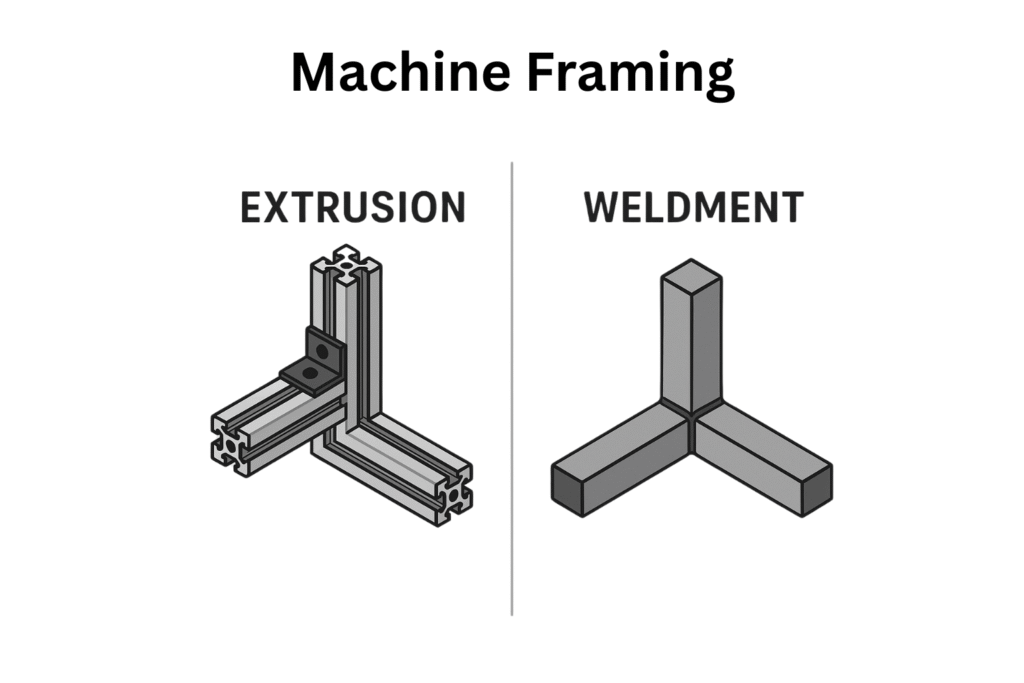
T-slot aluminum extrusion is a versatile and modular framing solution widely used in industrial automation, machine building, and custom engineering applications. Its unique design allows for easy assembly and reconfiguration without the need for welding, making it a preferred choice for manufacturers and engineers looking for efficiency and flexibility. Whether constructing workstations, automated systems, or structural frameworks, T-slot extrusion provides a scalable and cost-effective alternative to traditional welded steel structures.
Machine Framing & T-Slot Extrusion
Introduction
T-slot aluminum extrusion is a versatile and modular framing solution widely used in industrial automation, machine building, and custom engineering applications. Its unique design allows for easy assembly and reconfiguration without the need for welding, making it a preferred choice for manufacturers and engineers looking for efficiency and flexibility. Whether constructing workstations, automated systems, or structural frameworks, T-slot extrusion provides a scalable and cost-effective alternative to traditional welded steel structures.
What is T-Slot Extrusion?
T-slot aluminum extrusion consists of aluminum profiles with integrated grooves that allow for easy assembly using connectors and fasteners. These slots serve as attachment points for accessories, panels, and motion control components, making the system adaptable to various engineering needs.
Benefits of T-Slot Extrusion
T-slot extrusion offers several advantages over traditional welded steel framing:
- Modular Design: Components can be rearranged, expanded, or modified without specialized tools.
- Lightweight & Strong: Provides excellent strength-to-weight ratio, making it ideal for automation.
- Corrosion Resistance: Anodized aluminum resists rust and degradation, ensuring longevity.
- Easy Assembly: Requires minimal hardware—T-nuts and brackets make connections simple.
- Cost Savings: Reduces labor costs since welding, painting, and finishing are unnecessary.
- Improved Aesthetics: Sleek and professional appearance ideal for display and presentation applications.
Types of T-Slot Extrusion
T-slot profiles come in various styles and specifications based on load requirements and application needs:
- Standard Profiles: General-purpose extrusions suitable for machine frames and enclosures.
- Heavy-Duty Profiles: Designed for higher load-bearing applications such as conveyor systems.
- Ultra-Light Profiles: Optimized for mobile workstations and ergonomic structures.
- Custom Extrusions: Modified profiles for specialized industrial applications.
Reasons to Use T-Slot Extrusion
- Adaptability: Can be used for workstations, material handling, protective guarding, and automation.
- Scalability: Expandable designs allow for modifications and upgrades over time.
- Ease of Integration: Compatible with industrial components like actuators, linear guides, and sensors.
- Sustainability: Recyclable and eco-friendly materials contribute to green manufacturing initiatives.
How to Design with T-Slot Extrusion
Designing with T-slot extrusion involves careful planning to ensure structural integrity and functionality:
- Define Load Requirements: Select the appropriate profile strength based on application needs.
- Choose Fasteners & Connectors: T-bolts, spring nuts, and brackets provide secure assembly.
- Incorporate Motion Components: Add linear guides, actuators, and sensors for automation.
- Optimize Space Utilization: Arrange profiles efficiently to enhance workflow and ergonomics.