Encoders
Encoders are the unsung heroes of industrial automation and motion control. They provide precise feedback about position, speed, and direction — critical inputs for any closed-loop system. Whether you’re working with robotics, CNC equipment, conveyor systems, or precision stages, the encoder you choose can dramatically impact your system’s performance.

Types of Encoders

What to Consider When Choosing an Encoder
To specify the right encoder for your application, consider:
| Parameter | Questions to Ask |
|---|---|
| Motion Type | Is the motion linear or rotary? |
| Accuracy Needed | Do you need micron, sub-micron, or millimeter resolution? |
| Environmental Factors | Is the application subject to dust, oil, vibration, or moisture? |
| Power-On Behavior | Can you afford to home the system on startup, or do you need absolute feedback? |
| Distance/Travel | How far is the travel range? Will the scale fit? |
| Interface | What type of control system do you use (e.g., TTL, SSI, EtherCAT)? |
| Budget Constraints | What’s your performance vs. cost priority? |
Rotary Encoders

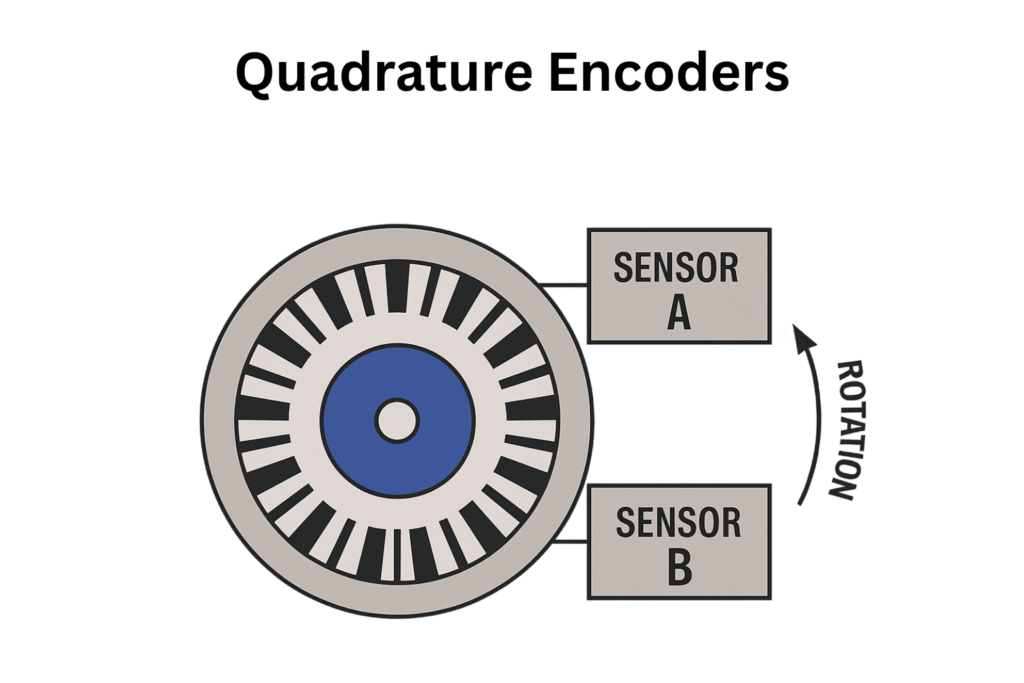
Rotary encoders are sensors used to measure the angular position, speed, or direction of a rotating shaft. They convert mechanical motion into electrical signals, providing critical feedback for motor control, robotics, CNC machinery, and industrial automation systems. By tracking rotation with precision, rotary encoders enable closed-loop control, improve accuracy, and enhance repeatability. Depending on the application, rotary encoders can be incremental or absolute, and they are available in various technologies including optical, magnetic, capacitive, and inductive — each with its own strengths for different environments and performance needs.
Types of Rotary Encoders
Incremental Rotary Encoders
- Provide pulses as the shaft rotates.
- Do not retain position when power is lost.
- Require a reference (homing) procedure on startup.
- Defined by Pulses Per Revolution (PPR) — common ranges from 1,000 to 20,000 PPR.
Absolute Rotary Encoders
- Output a unique digital value for each angular position.
- Do not require a homing sequence.
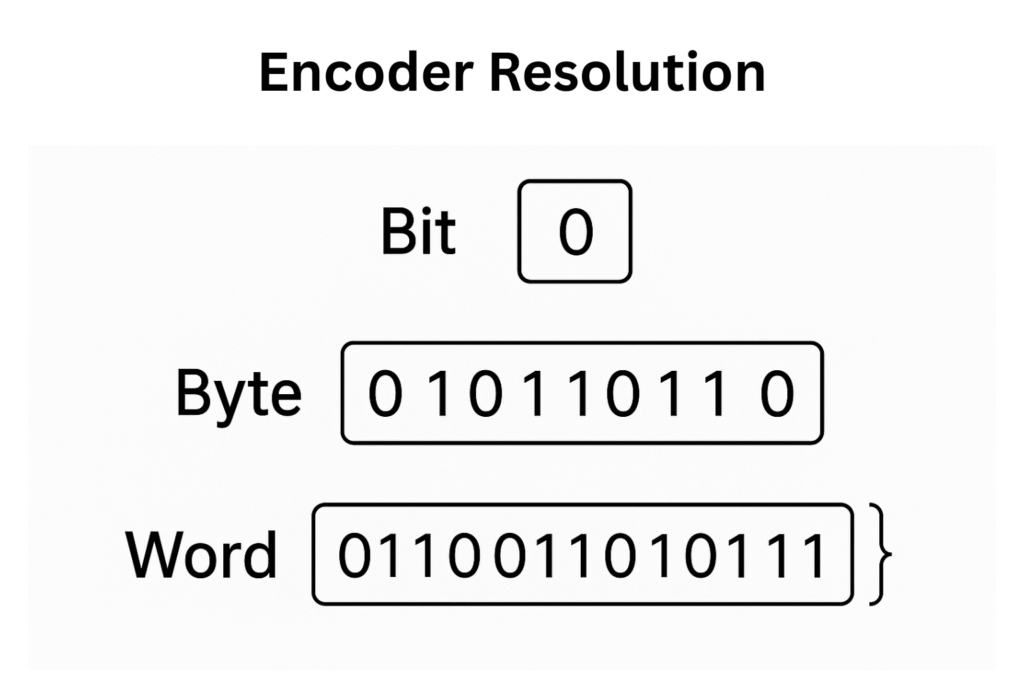
- Bit resolution determines accuracy — a 12-bit encoder has 4,096 discrete positions per revolution, while a 20-bit encoder offers over 1 million.
- Available in single-turn and multi-turn versions:
- Single-turn: Track position within one revolution.
- Multi-turn: Track both position and number of revolutions.
Rotary Encoder Technologies
- Optical: High precision, uses a code disc and light source.
- Magnetic: Robust, less sensitive to dust and vibration.
- Capacitive: Durable, power-efficient, ideal for compact designs.
- Inductive: Extremely rugged, good for harsh industrial environments.
Key Considerations
- Required resolution
- Operating environment (temperature, vibration, contamination)
- Mounting style (shafted, hollow shaft, through-bore)
- Communication protocol (analog, TTL, HTL, SSI, BiSS, Ethernet/IP)
Linear Encoders

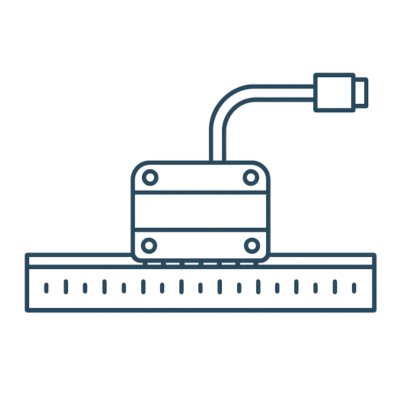
Linear encoders are precision sensors that measure straight-line (linear) motion by converting displacement into an electronic signal. Used extensively in machine tools, semiconductor equipment, precision stages, and metrology systems, linear encoders provide accurate position feedback for high-performance automation. They enable precise positioning, smooth motion control, and repeatable accuracy — critical in applications demanding sub-micron or even nanometer-level resolution. Linear encoders are available in incremental and absolute formats and use a variety of technologies such as optical, magnetic, capacitive, or inductive sensing, allowing engineers to tailor the solution to the environment and accuracy requirements of the application.
Types of Linear Encoders
Incremental Linear Encoders
- Emit pulses as the scale is moved.
- Position must be re-referenced after power loss.
- Simpler and more cost-effective.
Absolute Linear Encoders
- Provide a unique digital value at every position.
- Maintain position information even after shutdown.
- Ideal for high-precision applications that can’t tolerate re-homing.
Linear Encoder Technologies
- Optical: High-resolution scales with precision gratings; offers sub-micron accuracy.
- Magnetic: Durable, with moderate resolution; great for harsh environments.
- Capacitive: Used in compact designs with moderate accuracy needs.
- Laser Interferometry: Used in ultra-high precision systems (nanometer to sub-nanometer accuracy).
Key Considerations
- Accuracy and repeatability requirements
- Environmental conditions (cleanroom vs. factory floor)
- Scale length and installation footprint
- Mounting alignment tolerance
- Signal output (analog sine/cosine, digital A/B/Z, or serial communication)
Choosing the Right Encoder for Your Application
When determining the right encoder, consider:
- Resolution: How precise must your system be?
- Speed: What is the maximum velocity of the axis?
- Power cycles: Can the system afford to re-home on every power-up?
- Environment: Is the system exposed to dust, oil, or vibration?
- Mounting constraints: Is space limited or unusual?
Custom Encoder Integration
We don’t just sell encoders — we integrate them into complete motion control systems. Our team can help select, install, and calibrate the encoder solution that meets your application needs, whether it’s for semiconductor metrology, precision automation, or rugged industrial motion.
Need help selecting an encoder? Contact us for personalized guidance.