
Title: The Evolution of Go-To-Market Strategy in Industrial Automation: Why Manufacturers Must Adapt Now
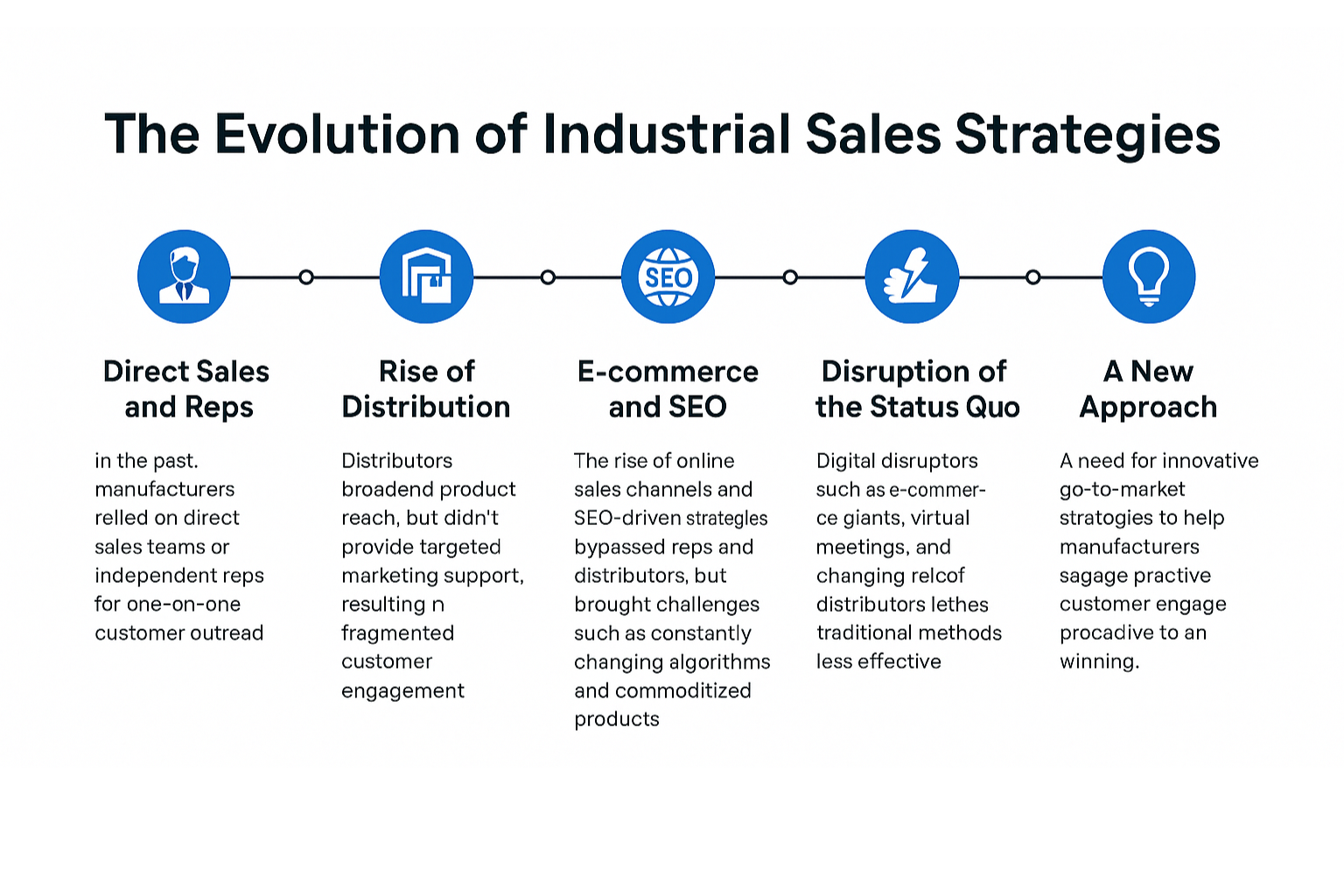
For decades, manufacturers in the industrial automation space have relied on traditional go-to-market strategies to reach customers and grow revenue. From direct sales teams to expansive distributor networks to independent manufacturers’ rep firms, the industry has seen wave after wave of structural change. Today, however, the speed and scale of disruption are unprecedented. Technological evolution, shifting buyer expectations, and seismic changes in how commerce is conducted demand that manufacturers rethink how they approach growth.
This post walks through the history of go-to-market strategy in industrial automation, outlines why the old methods are faltering, and introduces the emerging model designed to fill the critical void: proactive outbound marketing through a dedicated, performance-driven partner.
1. From Direct Sales to Distributor Dominance
In the early days of industrial manufacturing, most companies employed direct salespeople. These individuals worked for the manufacturer, carried a single line, and focused exclusively on growing their employer’s revenue. This was the “golden era” of mindshare—where the manufacturer had full attention from their sales staff. The investment was high (salaries, benefits, travel), but the focus was 100%.
As markets expanded geographically and operational costs rose, manufacturers began shifting to a distribution model. Distributors offered a cost-effective way to scale sales, leveraging relationships and logistics infrastructure to resell products regionally or nationally. In exchange, they earned margin—typically 30%.
Distributors were often granted territorial exclusivity. Loyalty was assumed. The manufacturer’s name sat proudly on the distributor’s line card, often one of only five to ten brands. It worked—for a while.
2. Rise of the Manufacturer’s Rep Firm
As product portfolios grew and territories splintered, the model shifted again. Independent manufacturer rep firms emerged as an in-between solution. Reps carried multiple lines but did not purchase inventory or manage logistics. They earned 5-10% commission on closed business.
For manufacturers, reps offered a flexible, lower-risk way to expand coverage. But reps were rarely responsible for finding new business. Their incentives favored farming existing accounts over hunting new ones. To make matters more complex, reps only got paid once a customer received product and paid the invoice—a cycle that could take 6+ months.
3. Marketing Enters the Scene
In the 2000s, with the rise of the internet, manufacturers turned to marketing firms for lead generation. Agencies offered web design, SEO, content creation, and social media management. The goal was to “get found” by potential customers.
This shift worked well when buyers still relied on Google. But the landscape has changed.
4. The New Buyer: Educated, Independent, and Algorithm-Driven
Today’s buyers are the most informed in history. They conduct research independently, lean on AI tools like ChatGPT, and avoid speaking to salespeople until deep into the buying cycle. The traditional marketing model, focused on SEO and keyword strategies, is losing efficacy. Google is no longer the front door to product discovery—AI is.
Meanwhile, the rise of e-commerce and platforms like Amazon have reset expectations. Speed, self-service, and instant information are now table stakes. Distributors no longer need to carry inventory to be viable—everything can be drop-shipped. The value of stocking has diminished, and the value of proactive business development has never been higher.
5. The Line Card Illusion
Many manufacturers still believe that being on a distributor’s line card guarantees visibility and attention. But today, those line cards have ballooned—with some listing 50, 100, even 200 different brands.
Ask yourself: If your distributor represents 100 companies, how much of their focus is truly on you? 1%? And do you think they only sell what’s on the line card?
If they can quote and source competitive products not even listed, what are you really getting?
Loyalty has eroded. Mindshare is diluted. And the illusion of coverage is costing you opportunities.
6. COVID and the Rise of Remote Business Development
The pandemic accelerated the digital transformation. Zoom replaced lunch meetings. Teams replaced trade show booths. Sales cycles moved online.
Manufacturers that once relied on face-to-face networks now find themselves needing scalable, digital outreach. But reps weren’t trained for outbound. Distributors don’t do it. And marketing firms aren’t compensated for results.
So who’s left to fill the gap?
7. A New Model: The 5-5-5 Strategy
AutoMotion Dynamics was built to fill this gap. We don’t identify as a rep, distributor, or marketing firm—we’re a new breed.
Our model is simple:
- 500 contacts/month sourced from your ideal customer profile
- 5 structured touchpoints (emails, calls, LinkedIn, follow-ups)
- 500 cold calls to support the campaign
We send all communications from your domain, only promoting your products, technologies, and capabilities. Everything is logged in a dedicated CRM—providing quantifiable, accountable, and transparent metrics. We even taper campaigns over a 6-month journey to ensure long-term nurturing.
8. Why This Works
Unlike reps or distributors, we’re paid to generate new business. And unlike agencies, we participate in the transaction as the reseller. That means our incentives are fully aligned with yours.
This is not a pipe dream. It’s a repeatable, proven process. It creates a bridge between marketing, sales, and distribution that has been missing for years.
9. Final Thought: If You Don’t Invest in New Business, Who Will?
Manufacturers who expect distributors or reps to proactively grow their territory without compensation are operating on hope, not strategy.
Outbound sales is labor-intensive. It requires systems, talent, tools, and persistence. If you’re not investing in it, no one is.
Let’s Talk
If any part of this message resonated with you, let’s connect.
We’re not here to replace your current partners. We’re here to support them with scalable outbound horsepower.
Let’s explore a strategic partnership built for growth.
[Book a meeting with AutoMotion Dynamics]